Updated September 2026
TL;DR: Speech in noise is the hardest problem in hearing care, and the one people notice first. Hearing aids attack it with directional microphones, noise reduction, and on some models a second processor built for it. None solve it completely. Knowing where the limit sits saves a lot of disappointment.
Speech in noise is the reason most people finally book an appointment. Hearing at home is fine. Then a restaurant happens, or a family dinner, or a meeting with four people talking, and the words stop arriving. That gap is not a quirk of your hearing. It is the central problem the industry is built around, and it is worth understanding what technology can do about it before you spend anything.
Why Speech in Noise Is So Hard
Hearing loss is rarely a uniform loss of volume. It usually takes the high frequencies first, and high frequencies carry the consonants.

- Vowels are loud and low. They survive hearing loss and they survive background noise.
- Consonants are quiet and high. S, f, th, k and t are where meaning lives, and they are the first to go.
- Noise masks the quiet sounds first. So a room full of talk removes exactly the sounds you were already missing.
The result is specific. You can hear that someone is speaking and you cannot tell what they said. That is not stubbornness or inattention, and it is worth saying out loud to the people who love you.
It is also common. About one in three people in the U.S. aged 65 to 74 has hearing loss. Nearly half of those older than 75 have difficulty hearing, according to NIDCD research.
How Your Provider Measures Speech in Noise
A standard hearing test in a quiet booth can look reasonable while your real-world listening is falling apart. Speech-in-noise testing exists to catch that gap.
- The test: you repeat sentences presented against background babble, which gets progressively louder relative to the speech.
- The result: a measure of how much louder speech has to be than the noise before you can follow it.
- Why it matters: two people with identical audiograms can score very differently, and that difference changes the fitting.
Ask whether speech-in-noise testing is part of your appointment. It predicts your real life better than anything else on the chart. Reading about the power of audiograms first will make the results easier to follow.
What Hearing Aids Do About Speech in Noise
Three mechanisms are doing the work, and they are not equally powerful.
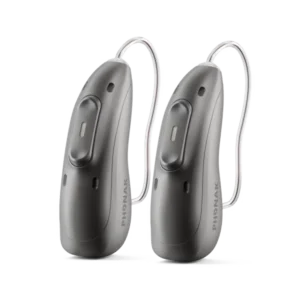
- Directional microphones. Two microphones per device favor sound from in front of you and suppress what arrives from behind. Oldest tool in the box, and still one of the most effective.
- Noise reduction. The device identifies steady, non-speech sound and lowers it. Good against traffic and fans, weaker against other voices, because other voices look like speech.
- Dedicated processing. Some current models add a second chip that does nothing but separate a talker from the babble in real time. This is the newest development and the one that changed what is possible, and our page on hearing aid innovation covers how it got here.
The second bullet is where most disappointment comes from. Babble is the hardest noise to remove, precisely because it has the same acoustic signature as the thing you are trying to hear.
The Current Technology, Compared
These are the current flagships from the lines we carry, ranked by how much of the device is committed to this one problem.
| Model | Processing | Dedicated noise chip | Directional mics |
|---|---|---|---|
| Phonak Audéo EON Sphere 90 | ERA plus HYPERSONIC | ✓ | Automatic and manual |
| ReSound Sensia 9 | 360 chip plus DNN chip | ✓ | Automatic |
| Phonak Audéo EON R 90 | ERA | No | Automatic and manual |
| Starkey Edge AI 24 | Edge AI processor | No | Automatic and manual |
Two of those run a second processor whose only job is this. If restaurants are your problem, that column is the one to read. More detail sits on our Phonak hearing aids and ReSound hearing aids pages.
Phonak Audéo EON Sphere
The Sphere family pairs the ERA chip with HYPERSONIC, a second processor running real-time AI on incoming sound. Spheric Speech Clarity 3.0 and AutoSense OS AI 8.0 both run here. AutoSense is the part that switches programs on its own as you move from a quiet street into a loud room.
ReSound Sensia
Sensia takes the same two-chip approach with different architecture. A 360 chip handles the sound and a separate DNN chip runs neural noise reduction, all of it in a microRIE shell, which is among the smaller rechargeable styles.
Where the Technology Still Falls Short
No hearing aid gives you normal hearing in a loud room, and any page suggesting otherwise is selling you something. Here is the honest boundary.

- Competing voices remain the hard case. Steady noise is tractable. A table of six people is not, for any device on the market.
- Directional microphones assume the talker is in front of you. Turn your head and the benefit moves with it.
- Reverberation defeats a lot of the processing. Hard floors, high ceilings and bare walls are worse than raw volume.
- Untreated loss changes how the brain handles speech over time. The longer the wait, the more relearning a fitting involves.
That last point is the strongest argument for acting sooner rather than waiting for it to get bad enough. It is also the one people find hardest to hear.
What You Can Do Beyond the Hearing Aid
The device is one half. Room choice and conversation habits are the other, and they cost nothing.
| Do this | Why it works |
|---|---|
| Sit with your back to the wall | Directional microphones suppress what comes from behind you |
| Choose booths and corners over open rooms | Soft surfaces cut the reverberation that defeats processing |
| Face the person speaking | Lip reading adds more than most people expect, even with good hearing |
| Ask for rephrasing, not repetition | Different words carry different consonants, so a rewording often lands |
| Ask about a remote microphone | It sends the talker’s voice straight to your hearing aids and beats every other option in a loud room |
The last row is underused. A remote microphone outperforms any amount of on-device processing, because it removes the distance between the talker and the microphone entirely.
Getting Speech in Noise Sorted with American Hearing + Audiology
Speech in noise is a fitting problem before it is a shopping problem, so our providers start with a test rather than a device. We carry five premium brands and recommend across all of them, and the recommendation follows how you scored and where you struggle. Options run from entry level through premium flagship, and using your insurance is often part of the picture, because we are in network with many major plans.
What that involves:
- A 7-day trial lets you hear the difference before you commit, in your own restaurants rather than ours.
- Real ear measurement is available at many locations, which verifies the fitting in your ear rather than estimating it.
- Hearing aids fitted with us are unlocked, so they can be serviced elsewhere if you move.
- We can check your benefits before you decide anything.
- Locally owned and operated means the person who fits you is the person you see at follow-up, and meet our team shows you who that is.
Hearing better starts with one conversation. Book a free hearing screening and find a clinic near you.
Speech in Noise Questions, Answered
Why can I hear people but not understand them in noise?
Hearing loss usually takes high frequencies first, and consonants live there. Vowels stay audible, so speech still sounds present while the meaning goes missing. Our providers at American Hearing + Audiology test specifically for this, because a quiet-booth result can look fine while your real listening does not.
Which hearing aids are best for speech in noise?
Models with a second processor built for the problem lead here, which today means the Phonak Audéo EON Sphere and the ReSound Sensia. Best for you still depends on your audiogram, your ear shape and where you struggle. Treat that as a starting point rather than an answer.
Will hearing aids let me hear normally in a restaurant?
No, and anyone promising that is overselling. Good hearing aids fitted well make a substantial difference in noise. A table of competing voices remains hard for every device on the market, which is why seating and remote microphones still matter.
How is a speech-in-noise test scored?
You repeat sentences presented against background babble that gets progressively louder. The result shows how much louder speech has to be than the noise before you can follow it, and two people with matching audiograms can score very differently. That difference changes the fitting your provider builds.
Can a remote microphone help with speech in noise?
Yes, often more than any on-device processing. A remote microphone sits with the person you want to hear and sends their voice directly to your hearing aids, which removes the distance and most of the room. At American Hearing + Audiology your provider can show you whether your devices support one.
Talk with a hearing care provider who listens, and find a clinic near you.