
Updated February, 2026
Most people know hearing aids make sounds louder. But today’s devices do far more than amplify. Modern hearing aids function more like miniature computers — packed with AI processors, Bluetooth radios, motion sensors, and precision microphones. Understanding the parts of a hearing aid helps you make smarter decisions about your hearing health.
This guide covers every major component, what it does, and how today’s most advanced technology has transformed each one.
What’s Actually Inside a Hearing Aid?
At their core, hearing aids still follow a straightforward chain: capture sound, process it, and deliver it to your ear. But the technology powering that chain has advanced dramatically. Today’s devices contain six to eight distinct components, each playing a specific role.
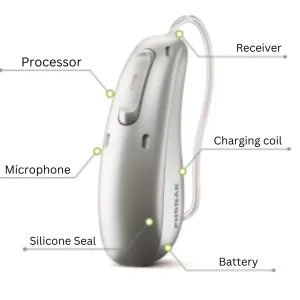
Here is a quick look at the core parts of a hearing aid before we go deeper into each one.
- Microphone: Captures incoming sound from your environment
- Processor (AI chip): Analyzes, filters, and shapes the sound signal
- Receiver: Converts the processed signal into sound inside your ear
- Battery or charging coil: Powers the entire system
- Silicone seal or dome: Positions the receiver comfortably in your ear canal
- Bluetooth/LE Audio radio: Connects to phones, TVs, and public sound systems
- Motion sensors: Adapt sound settings based on your movement and activity
- Telecoil (T-coil): Connects directly to hearing loop systems in public venues
That list might surprise you. A device smaller than a paperclip now runs dedicated AI chips, wireless radios, and inertial sensors simultaneously. Let’s look at each part and what it actually does for you. You can also explore how hearing aids work for a broader overview of the full sound journey.
The Microphone: Where Sound Enters
The microphone is the starting point for everything. It picks up sound waves from your environment and converts them into electrical signals the processor can work with.
Most modern hearing aids include two or more microphones. This matters because multiple microphones allow the device to compare signals and determine the direction of incoming sound. That comparison is what makes directional processing possible.
Modern microphone systems offer two core modes:
- Directional mode focuses on sound in front of you, making one-on-one conversations clearer
- Omnidirectional mode captures sound from all angles, keeping you aware of your full surroundings
The real advancement in recent years is how intelligently hearing aids switch between these modes. Earlier models required you to manually select a setting. Today’s processors — covered in the next section — detect your listening environment automatically and adjust microphone behavior in real time.
Research confirms that advanced directional microphone technology significantly improves speech understanding in noise for older adults with mild to moderate hearing loss.
If you live with hearing loss, microphone quality and the intelligence behind it directly affect how well you follow conversations in restaurants, meetings, and social settings.
The Processor: The Brain of a Modern Hearing Aid
This is where today’s hearing aids have changed the most. The processor — sometimes called the digital chip or signal processing unit — used to handle basic amplification and simple noise reduction. Now it runs deep neural network (DNN) AI models trained on millions of real-world sounds.
Think of it as the difference between a basic calculator and a smartphone. Both process numbers. Only one adapts to what you actually need.
Here is what modern hearing aid processors do:
- Classify your listening environment in real time, detecting noisy restaurants versus quiet living rooms
- Separate speech from noise using AI trained on millions of spoken sentences
- Cancel feedback before the whistling sound reaches your ear
- Reduce sudden loud sounds to protect your comfort
- Apply tinnitus relief sounds for people who experience ringing in their ears
- Manage Bluetooth streaming without draining battery faster than necessary
The gap between processor generations is significant. The Phonak Audéo Sphere Infinio uses a dual-chip architecture: one chip handles traditional sound processing while a dedicated DEEPSONIC AI chip separates speech from noise in real time. Phonak reports a 13 dB improvement in speech-to-noise ratio — a measurable, meaningful difference in demanding listening environments.
Oticon’s Intent uses DNN 2.0 trained on 12 million real-world sounds and pairs it with 4D sensor technology. That sensor package — covered below — feeds data back to the processor so it can adapt based on how you’re moving and what you’re paying attention to.
Research supports the real-world impact of these advances, showing that sophisticated hearing aid technology improves outcomes across communication, social engagement, and quality of life.
The processor also handles tinnitus masking programs for people dealing with persistent ringing or buzzing. It generates soothing sound therapy signals — like soft white noise or nature sounds — that draw the brain’s attention away from tinnitus. If this affects you, visit our tinnitus resource page for more on how hearing aids can help.
AI Processing Tiers: Not All Chips Are Equal
One important nuance: not every hearing aid in a brand’s lineup runs the same processor. Technology levels — premium, standard, and essential — reflect real differences in what the chip can do. A premium-tier device may process 20 frequency channels simultaneously. An essential-tier device may process eight. That difference matters in complex listening environments.
A hearing care provider helps you match processor capability to your actual lifestyle demands.
The Receiver: Delivering Sound to Your Ear
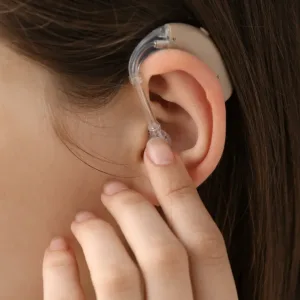
The receiver is the speaker of the hearing aid system. It takes the finely processed signal from the chip and converts it back into sound waves that travel directly into your ear canal.
Receiver-in-canal (RIC) and receiver-in-the-ear (RITE) designs place the receiver inside or very close to the ear canal. This positioning delivers sound more naturally and reduces the amount of amplification needed. It also makes the outer device smaller and lighter.
Receiver quality affects sound clarity, especially at higher frequencies. Better receivers reproduce the subtle tonal differences that make voices sound natural rather than mechanical. This is one reason premium devices sound noticeably cleaner than budget models — even when the microphone and processor are similar.
Receivers connect to the main device body through a thin wire. They also wear out over time and collect debris. Most hearing care providers recommend receiver checks during regular service visits.
The Battery and Charging Coil: Powering Everything
Every part of a hearing aid runs on power, and how that power works has transformed dramatically over the past five years.
Rechargeable Systems
Most premium and mid-tier devices now use lithium-ion rechargeable batteries. You place the hearing aids in a charging case overnight — similar to wireless earbuds — and they run all day on a single charge.
Battery life varies by model and usage. The Phonak Audéo Sphere Infinio leads the category at up to 56 hours per charge. The Starkey Edge AI delivers up to 51 hours for RIC models. Oticon Intent and ReSound Vivia run approximately 20 hours per charge, which still covers a full waking day comfortably.
Quick-charge features now appear across most flagship lines. A 30-minute charge on the Phonak Sphere gives you 8 hours of use. The Starkey Edge AI delivers 3 hours of use from just 10 minutes of charging.
The Phonak diagram above labels both the battery and charging coil as distinct components. The coil is the inductive element that transfers power wirelessly from the case into the device — no metal contacts required on many newer models. This design improves durability and moisture resistance.
For a detailed comparison of rechargeable options, see our rechargeable hearing aids guide.
Disposable Battery Option
Some users still prefer zinc-air disposable batteries. These activate when you remove the factory-sealed sticker on the back. They come in four color-coded sizes to match different device styles. Disposables suit people who prefer not to manage nightly charging or who travel frequently without reliable power access.
The Silicone Seal, Dome, and Earmold: The Fit Components
Sound delivery only works if the receiver sits correctly in your ear. The silicone seal and dome components handle that job — and they affect comfort, feedback, and sound quality more than most people realize.
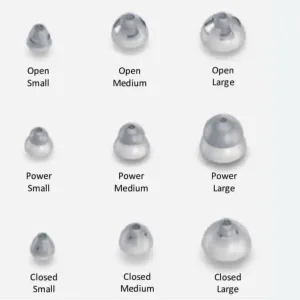
Domes are soft, flexible silicone cups that slide onto the receiver tip. They come in different sizes and shapes — open, closed, tulip, and power styles — to match different levels of hearing loss and ear canal anatomy. Open domes allow low-frequency sounds to pass naturally, reducing the “plugged up” sensation. Closed and power domes block the canal for people who need more amplification.
Choosing the right dome matters significantly to your experience. Our ultimate guide to hearing aid domes covers the differences in depth.
Custom earmolds replace domes for people with severe hearing loss or unusual ear canal anatomy. A hearing care provider takes a physical or digital impression of your ear and orders a mold manufactured specifically for you. Custom earmolds maximize amplification efficiency and reduce feedback by sealing the canal precisely.
Wax guards sit at the tip of the receiver to block earwax from entering the device. They need regular replacement — typically every one to three months, depending on how much wax your ears produce. Skipping this step leads to muffled sound or receiver damage.
Modern Components That Didn’t Exist a Decade Ago
The parts of a hearing aid now extend well beyond the traditional microphone-chip-receiver chain. Three components have become central to the modern hearing aid experience.
Bluetooth and LE Audio Radio
Today’s hearing aids contain full wireless radios. Bluetooth 5.3 and LE Audio connectivity let you stream audio directly from your phone, television, or computer. You can take phone calls, listen to podcasts, and adjust your device settings through a smartphone app — all wirelessly.
The newest standard, Bluetooth LE Audio with Auracast, allows hearing aids to connect to public broadcast systems in airports, theaters, and houses of worship. The ReSound Vivia is the first hearing aid to offer fully activated Auracast. Phonak, Oticon, and Starkey devices are Auracast-ready, with activation expected in coming updates.
For a full breakdown of wireless features, visit our guide to Bluetooth hearing aids.
Motion Sensors and 4D Technology
Oticon Intent introduced 4D sensor technology — a system that monitors four data streams simultaneously: conversation activity, head movement, body movement, and the acoustic environment. The processor uses that data to decide how aggressively to focus the microphone and how much noise reduction to apply.
The practical effect is significant. When you’re sitting still and talking, the device focuses tightly on speech in front of you. When you stand up and start walking, it broadens its awareness to keep you safe and connected to surrounding sounds. The device adapts without any input from you.
Starkey Edge AI includes similar motion-based features alongside health tracking capabilities, including fall detection.
Telecoil (T-Coil)
The telecoil is a small magnetic sensor coil built into many hearing aids. It picks up audio signals transmitted through hearing loop systems installed in public venues — theaters, churches, courtrooms, and transit hubs. When you activate the T-coil, background noise drops out and the audio source transmits directly to your hearing aid.
Not all hearing aids include a T-coil. Smaller devices like completely-in-canal (CIC) styles typically lack the space for one. If you regularly attend events in loop-equipped venues, T-coil capability is worth prioritizing when selecting a device. Learn more about how telecoils enhance your hearing aid experience.
How All the Parts Work Together
Understanding each component individually is useful. Seeing how they work as a system is where it gets impressive.
In a single moment in a noisy restaurant, here is what happens inside your hearing aid:
- Two microphones capture sound from all directions simultaneously
- The processor classifies the environment as “restaurant” within milliseconds
- The AI chip isolates the voice of the person across the table and suppresses surrounding noise
- The receiver delivers the enhanced signal into your ear canal
- The motion sensor confirms you’re seated and tightens the directional focus
- The Bluetooth radio simultaneously streams a call notification from your phone
All of this happens continuously, automatically, and without you touching a single button. That is the promise of current-generation hearing aid technology.
Find the Right Parts of a Hearing Aid for Your Life
Understanding the parts of a hearing aid puts you in a stronger position to choose the right device. The right processor tier, receiver style, dome fit, and connectivity features all depend on how you live and where you spend your time.
At American Hearing + Audiology, we carry five major hearing aid brands — Phonak, Starkey, ReSound, Oticon, and Unitron — so we match you to technology based on your actual hearing needs, not on what we happen to stock. We use real ear measurement at every fitting, a gold-standard verification step that only about 30% of providers in the U.S. perform. That means the parts of your hearing aid work together correctly from day one, not after weeks of trial-and-error adjustments.
We accept all major insurance carriers and handle billing directly. A 7-day risk-free trial comes standard. Remote care is available when you need a quick adjustment without making a trip in.
Ready to hear better with confidence? Find a clinic near you and talk with a hearing care provider who can walk you through every option.
Your Parts of a Hearing Aid Questions Answered
Do all hearing aids have the same components? All hearing aids include a microphone, processor, and receiver. Beyond that, components vary by style and technology level. Smaller in-canal devices may omit Bluetooth radios and telecoils due to size constraints. Premium devices add AI chips, motion sensors, and advanced charging systems that budget models do not include.
What is the most important part of a hearing aid? The processor has the greatest impact on sound quality and listening comfort. It determines how well the device separates speech from noise, manages feedback, and adapts to different environments. Microphone and receiver quality matter significantly too, but processor capability drives the biggest performance differences between devices.
How long do hearing aid components last? The main device body typically lasts five to seven years with proper care. Wax guards need replacement every one to three months. Domes wear out every two to four weeks. Receivers may need replacement every two to three years, depending on moisture exposure and earwax levels. Rechargeable batteries typically hold strong capacity for three to five years.
Can hearing aid parts be replaced individually? Yes. Wax guards, domes, receivers, and earmolds replace independently without replacing the entire device. This makes routine maintenance affordable. Your hearing care provider can handle most replacements during a standard service visit.
What is a charging coil in a hearing aid? A charging coil is the component that transfers power wirelessly from the charging case into the hearing aid battery. It works through inductive charging — similar to wireless phone chargers — with no metal contacts required on newer models. This design improves moisture resistance and reduces mechanical wear on the device.