Hearing loss does not arrive all at once. It moves through stages, from barely noticeable to profound. Each stage shapes how you connect with the people and sounds around you. Knowing the degrees of hearing loss helps you recognize where you stand. This guide walks through every level and how today’s hearing care can help.
What Are Degrees of Hearing Loss?
Hearing care providers measure hearing loss in decibels (dB) using a test called an audiogram. Your results show the softest sounds you can hear at different pitches. The quieter the sound you can detect, the better your hearing.
Audiogram results group into five recognized degrees of hearing loss. Each one reflects how much volume you are missing.
The five degrees of hearing loss are outlined below:
- Mild: 26–40 dB hearing loss
- Moderate: 41–55 dB hearing loss
- Moderately severe: 56–70 dB hearing loss
- Severe: 71–90 dB hearing loss
- Profound: 91+ dB hearing loss
Hearing care providers across the United States use these categories. Global health organizations use a similar classification system. According to research published in the Bulletin of the World Health Organization, more than 466 million people worldwide live with disabling hearing loss. That number is expected to nearly double by 2050.
Knowing which degree applies to you is the first step toward better hearing.
How Hearing Loss Is Measured
Decibels (dB) measure sound volume. Hertz (Hz) measure pitch. Both matter when a hearing care provider evaluates your hearing.
A standard hearing test checks how well you hear different pitches at different volumes. The lowest volume you can detect at each pitch is your hearing threshold. Those thresholds plot on a graph called an audiogram.
Here is a quick reference for everyday sound levels:
|
Sound |
Approximate Decibel Level |
|
Whisper |
30 dB |
|
Refrigerator hum |
40 dB |
|
Normal conversation |
60 dB |
|
Vacuum cleaner |
70 dB |
|
City traffic |
85 dB |
|
Lawn mower |
95 dB |
|
Rock concert |
110 dB |
A person with mild hearing loss may miss whispers and soft conversation. Someone with severe hearing loss may struggle to hear a vacuum running nearby. Your audiogram tells the full story.
Mild Hearing Loss (26–40 dB)
Mild hearing loss is often the first sign that something has changed. You may hear voices but miss specific words. Soft sounds like rustling leaves or whispers may slip away entirely.
People with this degree of hearing loss commonly notice these issues:
- Asking others to repeat themselves more often
- Turning the TV up louder than family members prefer
- Struggling to follow conversations in noisy places
- Missing parts of phone calls
- Feeling tired after long social events
The fatigue is real. When your brain works overtime to fill in missed sounds, listening becomes exhausting. That extra effort is one of the earliest clues that mild hearing loss is affecting you.
Modern hearing aids respond very well to this degree of hearing loss. Devices like the Phonak Audéo Sphere Infinio Ultra and ReSound Vivia enhance soft sounds and speech naturally.

Moderate Hearing Loss (41–55 dB)
Moderate hearing loss makes everyday conversation a real challenge. Even one-on-one talks in quiet rooms feel like work. Background noise turns most settings into a struggle.
Common signs of moderate hearing loss include:
- Difficulty hearing speech at normal conversation volume
- Frequently misunderstanding words, even when you hear them
- Avoiding social situations because following along is hard
- Needing closed captions to enjoy TV or movies
- Trouble hearing children, women, or anyone with a softer voice
At this stage, untreated hearing loss starts to affect more than just your ears. Research links untreated hearing loss to cognitive decline, social isolation, and balance issues. We share more about this in our guide on healthy aging and hearing.
Moderate hearing loss almost always benefits from hearing aids. Models like the Starkey Edge AI and Oticon Intent offer strong speech-in-noise performance.
Moderately Severe Hearing Loss (56–70 dB)
Moderately severe hearing loss makes most spoken communication difficult without help. Even loud speech is hard to understand. Group conversations become overwhelming.
People with this degree of hearing loss often experience the following:
- Cannot follow conversation at normal volume
- Rely heavily on lip reading and visual cues
- Miss most of what is said in meetings, family gatherings, or church
- Withdraw from social events to avoid frustration
- Feel disconnected from spouses, children, and grandchildren
This stage has a major impact on quality of life. Treatment is essential, not optional. Our article on acknowledging the reality of hearing loss walks through the emotional side of accepting that it is time to act.
Premium hearing aids handle this stage with confidence. Features like Phonak’s DEEPSONIC AI chip and Oticon’s 4D Sensor technology deliver speech clarity in tough environments.
Severe Hearing Loss (71–90 dB)
Severe hearing loss means normal speech is inaudible. Only loud sounds break through. Communication without hearing aids becomes nearly impossible.
Hallmarks of severe hearing loss include:
- Cannot hear speech without a hearing device
- Loud environmental sounds may still be audible
- Heavy reliance on visual cues, written notes, or sign language
- Risk of social isolation and depression without treatment
- Greater safety concerns from missed alarms or warnings
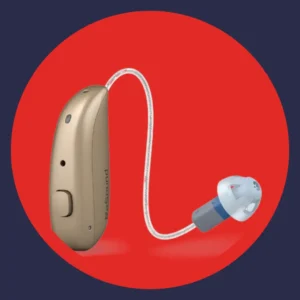
Hearing aids designed for this stage include the Phonak Audéo R Infinio and ReSound Nexia. Both deliver more amplification and stronger speech features. They also pair with remote microphones and TV streamers for added clarity. Curious how the technology works? Our guide on how hearing aids work breaks it down.
Profound Hearing Loss (91+ dB)
Profound hearing loss is the most significant degree of hearing loss. Most spoken sounds are not audible at all, even with shouting. Some people at this level are considered legally deaf.
Living with profound hearing loss often involves these realities:
- Little to no awareness of speech without amplification
- Reliance on sign language, lip reading, or written communication
- Use of high-power hearing aids or cochlear implants
- Visual alerts for doorbells, alarms, and phones
- Strong support network needed for daily activities
High-power hearing aids and cochlear implants are typical recommendations. A hearing care provider can evaluate which option fits your hearing and lifestyle. Our bilateral hearing loss guide covers what to expect when both ears are affected.
Types vs. Degrees of Hearing Loss
Degrees describe how much hearing loss a person has. Types describe what is causing it. Both shape your treatment plan.
The three main types of hearing loss are listed in the table below:
|
Type |
Cause |
Treatment |
|
Sensorineural |
Damage to inner ear hair cells or auditory nerve |
Hearing aids, cochlear implants |
|
Conductive |
Blockage or damage in outer or middle ear |
Medical treatment, surgery, hearing aids |
|
Mixed |
Combination of both sensorineural and conductive |
Combined approach based on cause |
Each type can occur at any degree of hearing loss. A person may have mild conductive hearing loss or severe sensorineural hearing loss. The combination of type and degree shapes the treatment plan. Our overview of hearing loss types explores each one in more depth.
Knowing both your type and your degree gives a complete picture of your hearing health.
At What Stage of Hearing Loss Do You Need a Hearing Aid?
Most hearing care providers recommend hearing aids starting at mild hearing loss. Waiting too long makes it harder for your brain to adapt later.
Reasons to consider hearing aids at the mild stage include:
- Your brain stays trained to process sound clearly
- Untreated hearing loss is linked to cognitive decline
- Communication and relationships improve quickly
- Modern hearing aids are nearly invisible
- Treatment now prevents harder adjustments later
Some people delay treatment because they think their hearing is not bad enough. Even mild hearing loss affects your daily life and your long-term brain health. Acting early is one of the best things you can do for your wellness.
Every degree of hearing loss benefits from a professional evaluation. A hearing care provider can recommend the right technology for your needs.
Can Hearing Loss Be Reversed?
Most permanent hearing loss cannot be reversed, but it can almost always be treated. Sensorineural hearing loss is the most common type. It happens when delicate hair cells in the inner ear are damaged. Those cells do not grow back.
Conductive hearing loss is sometimes reversible. Causes like earwax, ear infections, or middle ear fluid often respond to medical treatment. A hearing care provider can identify whether your hearing loss has a treatable cause.
Treatment options for permanent hearing loss include the following:
- Hearing aids: The most common solution for sensorineural hearing loss
- Cochlear implants: For severe to profound hearing loss when hearing aids are not enough
- Bone-anchored hearing systems: For specific conductive or single-sided hearing loss
- Assistive listening devices: TV streamers, remote microphones, and amplified phones
Treatment does not restore natural hearing, but it does restore your ability to engage with the world. Many people describe the experience as life-changing.
Why You Should Not Wait to Get Help
Untreated hearing loss has long-term consequences beyond missed conversations. Research has connected it to several serious health concerns.
The risks of leaving any degree of hearing loss untreated include:
- Higher risk of cognitive decline and dementia
- Increased likelihood of falls and balance problems
- Greater rates of social isolation and depression
- Heavier listening fatigue and mental exhaustion
- Strain on relationships with family and friends
Modern hearing aids do far more than amplify sound. Features like AI-powered speech enhancement, Bluetooth streaming, and rechargeable batteries make them effective and easy to wear. Many plans also offer coverage that helps reduce the cost. Learn more in our hearing aid insurance benefits guide.
Treating hearing loss early protects your brain, your relationships, and your independence.
Ready to Hear Better with Confidence?
Every degree of hearing loss deserves a thoughtful, personalized response. We are American Hearing + Audiology, and we are proud to be locally owned across Kansas City, Lincoln, Omaha, Tulsa, Memphis, and beyond. Our hearing care providers fit five premium hearing aid brands. You get truly brand-neutral recommendations based on your hearing and your lifestyle.
Here is what makes our care different:
- Real ear measurement at every fitting for verified accuracy
- 7-day free trial so you can experience hearing aids in real life
- In-network with most major insurance plans
- Remote care available for follow-up adjustments
- Local clinics with hearing care providers who know your name
Whether your hearing loss is mild or profound, our team will help you find the right path. Find a clinic near you and schedule a free hearing screening today. Want to start by location? Our guide to finding a hearing center near you makes it simple.
American Hearing + Audiology. In your network. In your neighborhood. In your corner.
Your Degrees of Hearing Loss Questions Answered
What are the five degrees of hearing loss?
The five degrees of hearing loss are mild (26–40 dB), moderate (41–55 dB), moderately severe (56–70 dB), severe (71–90 dB), and profound (91+ dB). Each one describes how much volume you are missing compared to typical hearing.
Is a 20 dB hearing loss serious?
A 20 dB hearing loss falls below the threshold for mild hearing loss in adults. It is sometimes called slight hearing loss. It can still affect how well you hear soft sounds and whispers. A hearing test confirms whether treatment would help.
What is a bad hearing test score?
A hearing test result is generally concerning when thresholds fall below 25 dB in adults. The lower the score, the greater the loss. Results between 26 and 40 dB indicate mild loss. Results above 90 dB indicate profound loss.
What level of hearing loss requires a hearing aid?
Hearing aids are typically recommended starting at mild hearing loss (26 dB and above). Early treatment helps your brain stay trained to process sound. It also reduces long-term risks linked to untreated hearing loss.
Can untreated hearing loss get worse over time?
Hearing loss itself often progresses naturally with age or noise exposure. Leaving it untreated can also make your brain less efficient at processing the sounds you do hear. This is sometimes called auditory deprivation. Treatment helps your brain stay sharp and responsive.
Can children have different degrees of hearing loss than adults?
Yes. Children are evaluated using slightly different thresholds because even mild hearing loss can affect speech and language development. A pediatric hearing care provider can identify and treat hearing concerns at any age.
What dB is legally deaf?
In the United States, a person is generally considered legally deaf when their hearing loss reaches 90 dB or greater in the better ear. This falls within the profound degree of hearing loss. Definitions can vary by state and program.