Updated October 2026
TL;DR: A free hearing test near you tells you whether your hearing has changed, by how much, and in which frequencies, and you can call and talk it through with a hearing care provider before you book anything. At American Hearing + Audiology the appointment costs nothing and carries no obligation.
Searching for a free hearing test near me usually means one of two things. Either you have noticed something and want to know how bad it is, or someone else noticed and you would rather find out quietly. Both are good reasons to come in, and neither one commits you to anything. A free hearing test near me search is usually the first step someone takes alone, so the useful thing to know is that you can talk to a person before you commit to a date.

You Can Talk to Someone Before You Book
Call the clinic nearest you and ask for a hearing care provider. You do not have to book, you do not have to give a reason, and you can ask anything you want about a free hearing test near me before you decide.
This matters more than it sounds. The most common reason people put off a hearing test is not cost and not time. It is not knowing what they are walking into, and the usual fix, reading a web page, does not answer the question they have, which is specific to their own ears and their own situation. A five minute phone call does.
Things worth asking on that call:
What the appointment will tell you, and what it will not
How long you will be there, so you can plan the rest of your day
Whether your insurance is one we are in network with, which we can check while you are on the phone
What happens if the results show nothing, which is a real and common outcome
Whether you can bring someone with you, because a second set of ears helps
None of that requires an appointment to find out. Call first, book second, and only if you want to.
What a Free Hearing Test Near Me Includes
A free hearing test near you is a no-cost hearing evaluation that measures how well you hear tones and speech, plus a look inside your ear canal. At American Hearing + Audiology it runs as a conversation, an examination and a set of measurements, and the results get explained to you before you leave.
The conversation comes first. Your provider asks where hearing is hardest for you, because a person who struggles in restaurants and a person who struggles on the phone have different problems and need different answers. Then comes the physical exam, an otoscope look at your ear canal and eardrum, which rules out earwax, fluid and infection. Plenty of hearing complaints turn out to be wax, and that is a good morning.
The measurements follow:
| What it measures | What the test is doing | What it tells your provider |
| Pure-tone audiometry | The softest tone you can hear at each pitch | Where your hearing sits against normal, frequency by frequency |
| Speech audiometry | How well you repeat words at a comfortable volume | Whether you hear sound but miss meaning |
| Speech-in-noise testing | Word recognition against background noise | How you will do in restaurants and groups, which pure tones cannot predict |
| Tympanometry | How your eardrum moves under pressure | Whether the problem is middle-ear rather than inner-ear |
Those four cover most people. Where something in the results needs following up, your provider will say so and explain what comes next.
How a Hearing Test Becomes a Prescription
Measurements are not the point of the appointment. What they produce is a prescription, and the way one becomes the other is the part almost nobody explains.
Your audiogram shows the quietest sound you can detect at each frequency, in both ears, separately. That is a map of where your hearing has dropped away and by how much. A hearing aid is not a volume knob, so it does not amplify everything. It amplifies each frequency band by the specific amount your audiogram says is missing at that band, and it leaves the frequencies you still hear well alone. Boosting those would make the device uncomfortable without helping you understand anything.
That is why two people with hearing described the same way in conversation can walk out with completely different settings. One has lost high frequencies and hears the vowels but misses the consonants, so speech sounds mumbled rather than quiet, and an across-the-board boost would make that person miserable without making anything clearer. A flatter loss is a different problem. There everything is simply faint, and the answer is closer to even gain across the range.
Speech-in-noise testing is what catches the gap between those two pictures. Pure tones are measured in a quiet room, and almost nobody complains about a quiet room. Testing word recognition against background noise is how the appointment measures the situation you came in about.
Reading Your Results
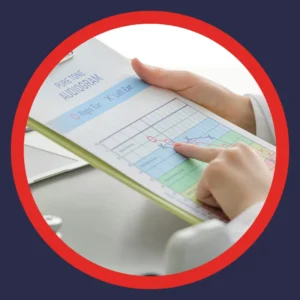
Your provider reviews the audiogram with you the same day, and there is no pass or fail on it. The chart plots pitch along the bottom and volume down the side, with your right ear marked in red and your left in blue, and where those marks sit tells you the degree of any loss.
| Threshold | Degree | What it usually feels like day to day |
| Up to 25 dB | Normal hearing | No consistent difficulty |
| 26 to 40 dB | Mild | Soft speech and group conversation get hard |
| 41 to 55 dB | Moderate | Normal conversation needs effort, the TV goes up |
| 56 to 70 dB | Moderately severe | Speech is unclear without amplification |
| 71 to 90 dB | Severe | Only loud speech comes through |
| 91 dB and above | Profound | Amplification alone may not be enough |
Even mild loss in the high frequencies is worth taking seriously, because consonants live up there and consonants carry meaning. That is the reader who says everyone mumbles.
Why Getting Tested Matters
Hearing loss that goes untreated is linked to higher dementia prevalence, and treating it appears to matter. A 2023 Johns Hopkins study of older adults found dementia prevalence 61 percent higher among people with moderate to severe hearing loss than among people with normal hearing. In the same study, hearing aid use was associated with 32 percent lower dementia prevalence among those with moderate to severe loss.
The working explanation is effort. When the signal reaching your brain is incomplete, the brain spends resources reconstructing it, and those resources are not available for listening, remembering and following along. That cost shows up as exhaustion at the end of a dinner party long before it shows up anywhere else.
Hearing also does safety work you do not notice until it is gone. Alarms, traffic, someone calling your name from another room. And it does social work: the withdrawal that follows untreated hearing loss usually starts with declining one invitation because the restaurant was too loud last time.
Who Should Book a Free Hearing Test Near Me
Anyone can book a free hearing test near them, and a baseline is useful even when nothing feels wrong, because your provider can only measure change against something. Come in sooner if any of these fit:
You are over 50, where age-related change starts to show up on an audiogram
You ask people to repeat themselves more than you used to
You follow one-on-one conversation fine but lose the thread in groups
You have ringing or buzzing in your ears
You worked around loud noise, in machinery, music, aviation or the military
Hearing loss runs in your family
You have diabetes or high blood pressure, both of which are linked to hearing loss
If none of those fit and you are simply curious, that is reason enough. The appointment is free and nothing about it obligates you.

What Happens After
You leave knowing where your hearing stands. Normal results end the appointment there, and your provider will tell you when to come back so the next audiogram has something to compare against.
Where there is loss, your provider explains what kind and talks through the options that fit it. Should hearing aids make sense, a 7-day trial lets you hear the difference before you commit, in your own kitchen and your own car rather than in a demo room. We fit Phonak, ReSound, Starkey, Oticon and Unitron, so the recommendation follows your audiogram rather than a single manufacturer’s catalog.
Some results point somewhere other than a hearing aid. Sudden loss in one ear, pain, drainage or dizziness get a medical referral, and wax gets removed.
How Insurance Fits In
Coverage depends on your plan, and we can check your benefits before you decide anything. We are in network with the major carriers and with the benefit administrators that manage hearing coverage for them, including TruHearing, Nations Hearing and United Healthcare Hearing.
Two things worth knowing before you call. A hearing benefit is usually a bundle with separate rules for the test, the devices and the follow-up visits, so a plan can be generous on one line and silent on another. And most benefits reset on a cycle, so an unused one may already have expired. Our benefits team runs both checks while you are on the phone. More on hearing aid insurance benefits.
Book Your Free Hearing Test Near Me
We are locally owned and operated, we fit five manufacturers rather than one, and we carry options across price tiers. Real ear measurement is available at many of our locations. In-network benefit verification happens before you decide anything, and every hearing aid we fit comes with a 7-day trial.
Hearing better starts with one conversation. If you have been searching for a free hearing test near me, call and ask your questions first if you would rather, or find a clinic near you and book when you are ready.
In your network, in your neighborhood, and in your corner.
Free Hearing Test Near Me: Questions People Ask
Is a free hearing test near me free, or is there a catch?
It is free. At American Hearing + Audiology there is no charge for the appointment and no obligation attached to it. You can leave with your results and nothing else, and plenty of people do.
How long does a free hearing test take?
At American Hearing + Audiology most first visits run about 90 minutes from arrival to leaving with a plan. The measurements themselves take a fraction of that. Most of the time goes to the conversation before and the explanation after, which is where the useful part happens.
Can I bring someone with me?
Yes, and it helps. A spouse or adult child often notices patterns you have adapted around without realizing, and they hear the recommendations alongside you, which makes the decision afterward easier.
What if my hearing turns out to be fine?
Then you have a baseline, which is worth having. Our providers keep it on file. Hearing changes slowly enough that people rarely catch it themselves, and a provider comparing next time against this audiogram will spot a shift years before you would.
Do I need a referral from my doctor?
No. You can call American Hearing + Audiology directly and book. If anything in your results points to a medical issue rather than a hearing one, your provider will refer you at that point.