Updated November 2026
| TL;DR: The right hearing aid domes depend on how much low-frequency hearing you still have. Open domes suit good low-pitch hearing, while closed, power or custom tips suit deeper loss. Swap in fresh hearing aid domes about every three months, or sooner if they stiffen, and have your provider verify any change of style with real ear measurement. |
Hearing aid domes look like a small detail, but they decide how your own voice sounds, whether your aids whistle, and how long you can wear them before your ears get sore. The soft silicone tip on a receiver-in-canal hearing aid sets how much natural sound reaches your eardrum and how much amplified sound stays in. That tip is the last step in how hearing aids work, where sound leaves the speaker and meets your ear. Get the dome right and the rest of the fitting has room to do its job.
What Are Hearing Aid Domes, and What Do They Do?
Hearing aid domes are the flexible tips that sit on the end of the receiver wire and hold the speaker in your ear canal. Each one does two jobs at once. It centers the receiver so sound points down the canal toward the eardrum. The same tip also controls how open or sealed your ear is.
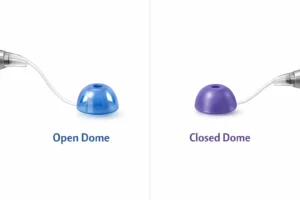
That second job is the one that changes what you hear. An open dome lets outside sound and your own voice flow in and out. A closed dome blocks most of it, so almost everything you hear comes through the hearing aid. Every dome style sits somewhere on that line between open and sealed. Think of an open dome as a screen door and a closed dome as a storm door: one lets the breeze through, the other keeps the heat in.
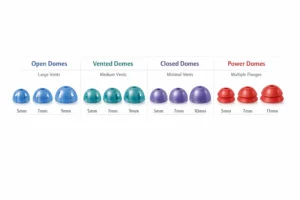
Domes come in a few shapes, and each shape trades one benefit for another:
- Open domes have large holes or slits, so the ear stays almost fully open and your voice sounds natural.
- Tulip domes use two overlapping petals. Your provider can trim or turn them to set a middle point between open and closed.
- Vented and closed domes seal more of the canal, keeping low-pitched amplification in while a small vent relieves pressure.
- Power or double domes stack two layers of silicone for the tightest seal a stock tip can give.
- Custom molds start from an impression of your ear. They replace the dome when a stock tip cannot seal or stay put.
Manufacturers name their versions differently. Phonak, for example, makes EasyGuard domes in Open, Vented and Power versions, plus custom earpieces called SlimTip and cShell.
Why Your Low-Frequency Hearing Decides the Dome
How much low-pitched hearing you still have is the single biggest factor in dome choice. That is because low-frequency sound behaves differently from high-frequency sound once it reaches a dome.
Low pitches pass easily through any opening. If your hearing for those sounds is still good, that is a gift. Natural low-frequency sound flows straight in through an open dome. The hearing aid only has to add the high pitches you are missing. Your voice stays your voice. But if your low-frequency hearing has also dropped, the hearing aid has to deliver those pitches too. Through an open tip, they leak right back out. So the dome has to close up to hold that sound in.
Occlusion Versus Feedback: The Tradeoff Behind Every Seal
Closing the ear has a cost. When you talk, chew or hum, your own voice vibrates through the bones of your head into the ear canal. An open ear lets that sound escape. A sealed ear traps it, and your voice turns hollow, boomy or plugged up. Clinicians call this the occlusion effect.
The seal pays you back in another way. Amplified sound that leaks out of the canal can loop back into the hearing aid microphone and squeal. Sealing the canal stops that leak, so the hearing aid can deliver more volume before it starts to whistle. A 2016 review in Trends in Hearing put numbers on both sides. Low-frequency sound dropped by about 4 dB for every extra millimeter of vent width, and fully avoiding occlusion could take a vent as wide as 5 mm. Compared with a custom earmold, open domes cut the volume available before feedback by about 25 dB, and closed domes by about 15 dB.
Put those forces together and every fitting becomes a balance between three things:
- Comfort of your own voice improves as the ear opens up, because trapped bone-conducted sound has somewhere to go.
- Low-pitch amplification improves as the ear closes, because the sound the aid adds stays in the canal.
- Feedback headroom improves as the ear closes, which matters most for moderate to severe loss that needs a lot of volume.
Your audiogram shows where you land on that balance before anyone picks up a dome.
Hearing Aid Domes Compared: Open, Tulip, Closed, Power and Custom
Every dome style suits a different hearing pattern and carries its own tradeoff. From most open to most sealed, they compare like this:
| Dome type | Seal | Best if your loss is | Own voice | Tradeoff |
| Open | Minimal | Mild to moderate, mostly in the high pitches | ✔ Most natural | Least volume before feedback, little low-pitch boost |
| Tulip | Adjustable | High-pitch loss with some low-pitch dip | ✔ Mostly natural | Petals can fold or shift if inserted at an angle |
| Vented | Partial | Moderate loss across more of the range | Slightly fuller | Some occlusion, more low-pitch support |
| Closed | High | Moderate to severe, including low pitches | Noticeably fuller | Occlusion for the first weeks, better in noise |
| Power or double | Highest stock seal | Severe loss that needs strong amplification | Plugged feeling | Can feel tight, needs a precise size |
| Custom mold | Shaped to your ear | Severe to profound loss, unusual canals, domes that slip | Depends on the vent drilled in | Needs an ear impression and a short wait |
The pattern holds across every brand: the more volume you need, the more seal you need to keep it.
When a Custom Mold Beats a Dome
A custom mold takes over when a stock dome cannot do the job. Some ear canals are too narrow, too wide or too curved for a round dome to hold. Certain losses need more volume than any stock seal can support without whistling. Other people push domes out when they chew or talk.
Molds also last longer than domes. They can carry a vent sized for your ear, so your provider can fine-tune occlusion more precisely. If you are weighing that route, these reasons to consider custom hearing aids walk through the fully custom options too.
Which Hearing Aid Dome Fits Your Hearing Loss?
The pattern of your hearing loss points to a starting dome. Your provider then confirms it in the ear. That pattern matters more than the overall degree of hearing loss, because two people with the same average can need very different tips. Each common pattern has a usual starting point:
| Hearing pattern | Typical starting dome | Why |
| Sloping high-frequency loss, good low pitches | Open or tulip | Natural low sound comes in on its own, the aid adds the highs |
| Flat mild to moderate loss | Vented or closed | The aid has to boost low and high pitches alike |
| Low-frequency (reverse slope) loss | Closed | Low-pitch amplification escapes through an open tip |
| Severe loss | Power or double, often a mold | High volume needs a tight seal to avoid feedback |
| Profound loss | Custom mold | Stock domes cannot hold the gain this level needs |
Treat the table as a starting point. Ear canal shape, dexterity and how much the occlusion bothers you can all move the final choice up or down a step.

How Do You Know What Size Hearing Aid Dome You Need?
Aim for the smallest dome that stays centered and sealed without pressing on the canal wall. Most hearing aid domes come in several diameters. Your provider sizes your canal by eye and with trial tips during the fitting.
Size matters because a dome that is too small slides around. It lets amplified sound leak out, which invites whistling. Loose tips also let the receiver tilt against the canal wall. A dome that is too large creases as it goes in. The fold breaks the seal and pushes on skin that was never meant to hold weight all day. Your two ears may also need different sizes, since canals are rarely identical.
These signs suggest the size is off:
- Whistling when you smile or chew usually means the dome is too small and shifts as your jaw moves.
- A sore spot after a few hours points to a dome that is too large or seated at an angle.
- Sound that fades in and out can mean the dome slides between sealed and unsealed.
- Finding the aid half out of your ear after a walk or a meal means the tip is not gripping.
A well-sized dome should disappear after the first week. If you still notice it, that is worth a visit.
Echo, Whistling or Soreness: What Your Dome Is Telling You
Most everyday complaints about hearing aid domes trace back to the seal, the size or wax. Knowing which one you are dealing with tells you whether to wait, clean or book a visit. Each complaint points to a likely cause and a likely fix:
- Echoey or boomy voice: the seal is trapping bone-conducted sound. Your brain often adjusts as you keep wearing the aids. If it persists past the first weeks, a more open dome or a larger vent often helps.
- Whistling or squealing: sound is leaking back to the microphone through a loose seal or a blocked wax filter. A snugger dome usually fixes it. This guide to hearing aid feedback covers other causes.
- Muffled or weak sound: wax on the dome or the receiver filter is the most common cause. A fresh dome and filter change often brings the sound right back.
- Soreness or itching: the dome may be too large, the silicone may have hardened with age, or the canal skin may be dry. If the skin feels raw, give that ear a break and have your provider take a look.
- Dome left in the ear: an old or loosely attached dome can pull off the receiver. Do not dig for it. Your hearing care provider can remove it safely.
If a problem returns after a clean, correctly sized dome is in place, the issue likely sits in the programming rather than the tip.
How Often Should You Replace Hearing Aid Domes?
Phonak recommends a fresh dome every three months, or sooner if it turns stiff or brittle. That makes a sound default for any brand, and the warning signs below tell you when to swap early. Silicone is soft by design, and body heat, ear oil and daily cleaning slowly stiffen it. A stiff dome seals worse, feels harsher and grips the receiver less firmly.
Replacement Timeline
Domes, wax guards and molds each run on their own clock:
| Your situation | Typical replacement |
| Standard dome | About every three months, per Phonak |
| Wax guard on a standard receiver | About every four weeks, per Phonak |
| Dome that is stiff, torn, discolored or loose | Right away, whatever the calendar says |
| Custom molds | Your provider checks them at visits and remakes them when the fit loosens |
Warning Signs It’s Time for New Domes
Do not wait for the calendar if a dome shows any of these:
- Yellowing or discoloration means the silicone has absorbed oils and is starting to harden.
- Stiffness or lost shape means the seal has weakened, so feedback becomes more likely.
- Tears, splits or a loose grip on the receiver raise the chance of the dome staying behind in your ear.
- Wax packed into the vents that will not wipe clean muffles sound and blocks airflow.
A spare pack of domes in your bag means none of these has to wait for an appointment.
How to Change a Hearing Aid Dome
Changing a dome takes under a minute once you have done it twice. Work over a towel or a table so a dropped dome does not disappear, and follow these steps:
- Wash and dry your hands so oil and dirt do not transfer to the new silicone.
- Hold the receiver, not the wire, so you do not bend the thin cable.
- Pull the old dome straight off with a firm, steady tug, without twisting.
- Check the wax filter at the tip of the receiver and change it if it looks dark or packed.
- Push the new dome on until it clicks or sits flush over the ridge, then tug it gently to confirm the grip.
- Insert the aid and check the sound. Your voice should sound the way it did with a fresh dome before.
Between changes, wipe your domes daily with a dry cloth or a tissue and let them air out overnight. Skip water and alcohol on the silicone unless your manufacturer says otherwise. These steps for cleaning hearing aids cover the rest of the device.
Why the Fitting Matters as Much as the Dome
Every dome changes the sound in your ear. So your provider has to check the programming with that dome in place. Swapping from an open tip to a closed one changes how much low-pitched sound reaches your eardrum. Settings that matched your prescription with one dome can miss it with another.
That is the reason real ear measurement exists. A thin probe tube sits beside the dome in your canal and measures what the hearing aid delivers at your eardrum. Your provider then adjusts the programming until it matches your prescription. The same 2016 review cited one study in which 71 percent of open fittings examined missed their prescription targets by more than 10 dB. You cannot hear that gap on your own, but a probe measurement can show it. This explainer on real ear measurement covers how the test works.
When you change hearing aid domes to a new style or size, or move to a mold, ask your provider to verify the fit again. A dome change is a small swap. The settings behind it deserve the same care as the first fitting.
Get Your Hearing Aid Domes Fitted and Checked at American Hearing + Audiology
Talk with a hearing care provider who listens. At American Hearing + Audiology, your dome choice starts with your hearing test and your daily life, then gets confirmed in your ear. Real ear measurement is available at many of our locations. Where it is, our providers measure your settings against your prescription instead of guessing. If you bought your hearing aids from us, a dome change or size check fits easily into any visit. Our providers can also show you how to swap tips at home.
Choosing the tip is only part of the fit. Your care also includes:
- Locally owned and operated clinics with hands-on testing, fitting and follow-up.
- Five premium brands, Phonak, ReSound, Starkey, Oticon and Unitron, so your recommendation is built around your hearing rather than a single catalog.
- Options across price tiers, from entry level through premium.
- In-network with many major insurance plans. We can check your benefits before you decide anything.
- A 7-day trial lets you hear the difference before you commit.
- Unlocked hearing aids, so your devices are not tied to one seller.
In your network, in your neighborhood, and in your corner. Find a clinic near you and start with a free hearing screening.
Common Questions About Hearing Aid Domes
Can I buy replacement hearing aid domes without seeing a provider?
Yes, once you know your dome style and size. Our providers at American Hearing + Audiology note both in your records. You can then reorder from our hearing aid accessories store. Switching to a different style is another matter. A new style changes your sound, so your provider should verify it in the ear.
Do both ears need the same type of dome?
Not always. Hearing often differs between ears, and so does canal size. It is common to wear a different size in each ear, and sometimes a different style. At American Hearing + Audiology, our providers fit each ear on its own results.
Can I use domes from a different hearing aid brand?
Usually not. Manufacturers design domes to lock onto a specific receiver. A mismatched tip can fit loosely or come off in the ear. Stick with domes made for your hearing aid model.
Will people be able to see my hearing aid domes?
Rarely. The dome sits inside your ear canal, so what shows is the thin receiver wire running over your ear. At American Hearing + Audiology, our providers can show you how the fit looks on your own ear before you choose.
Should I take my hearing aids out to shower or sleep?
Yes, for both. Soap and water can collect behind a dome, and overnight is when rechargeable aids charge and domes get a chance to dry out. At American Hearing + Audiology, our providers can walk you through a simple daily routine. To start, find a clinic near you.