TL;DR: The cocktail party effect lets your brain lock onto one voice in noise. Hearing loss weakens that filter, so crowded rooms get exhausting. Modern hearing aids and two-ear fittings help restore clarity in the crowd.
Picture a crowded restaurant where forks clink and three conversations overlap. Somehow your brain locks onto one voice and follows it. That skill is the cocktail party effect, and hearing loss quietly breaks it. Crowded rooms then turn tiring, and speech blurs into noise.
Coined by British cognitive scientist Colin Cherry in the 1950s, the term describes how we selectively attend to one speaker in noisy social settings. At a party, for example, you can concentrate on your friend’s story while music plays and dishes clatter.
Cherry’s research proved people can tune into a single voice, even when two different voices are heard, one in each ear. Remarkably, participants ignored one voice entirely, as if it had never occurred.
This complex feat involves selective attention, binaural hearing, and advanced brain processing. However, for people with hearing loss, the cocktail party effect often stops working effectively.

How Hearing Loss Disrupts the Cocktail Party Effect
People with hearing loss often notice a specific problem: they can hear that someone is talking, but they can’t understand the words.
This happens because hearing loss distorts the input your brain relies on to separate speech from noise. Our brains depend on binaural hearing, balanced sound input from both ears, to make sense of sound. With hearing loss, that balance breaks down.
A groundbreaking study by researchers at Oregon Health & Science University (OHSU) and the VA revealed why. Their research uncovered a condition called binaural pitch fusion, where people with hearing loss blend different sounds from each ear into one distorted result.
In the study, participants heard different vowel sounds in each ear: for instance, “ah” in the left ear and “ee” in the right. People with normal hearing could tell the sounds apart.
But individuals with hearing loss often heard an entirely new vowel, like “eh,”which wasn’t played at all. This blending makes speech difficult to understand in noisy places.
This abnormal fusion results in an unintelligible mash-up of speech sounds. It creates confusion, increases listening effort, and reduces comprehension, especially in multi-speaker settings.
These findings explain why people with hearing loss often say, “I can hear you talking, but I can’t make out what you’re saying.” It’s not just the ears: it’s how the brain receives and processes information.
Even mild hearing loss can disrupt the auditory processing system. That disruption leads to frustration, social fatigue, and eventually, withdrawal from conversations.
Think you’re too young for hearing loss? Learn about hearing loss among millennials and Gen Z.

How Hearing Aids Help Restore the Cocktail Party Effect
The good news? Modern hearing aids are designed to combat the effects of hearing loss on speech processing.
These devices don’t just make things louder: they help your brain understand speech more clearly. They restore balance between both ears and enhance your brain’s natural filtering ability.
Here’s how hearing aids tackle the cocktail party challenge:
- Noise Reduction Technology: Background chatter is softened, allowing speech to come through clearly.
- Directional Microphones: These focus on sounds in front of you and reduce sounds from other directions.
- Speech Enhancement Algorithms: They identify speech patterns and amplify them for easier understanding.
- Bilateral Communication: Devices on both ears work together to recreate the natural spatial hearing experience.
Hearing aids now include artificial intelligence (AI) that adapts to your environment in real time. This helps reduce listening fatigue and improves your ability to stay connected in noisy spaces.
We rounded up the top hearing aids for noisy settings in a separate guide. Below, three standout models show how this works in cocktail party situations.
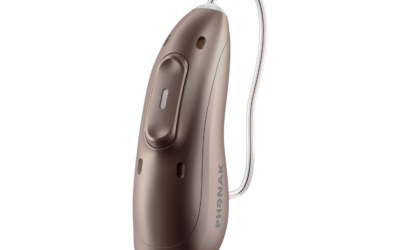
Phonak Audéo EON Sphere: Sound Focus for Loud Rooms
The Phonak Audéo EON Sphere is one of our picks for noisy rooms. It runs HYPERSONIC, a dedicated chip for speech in noise. Spheric Speech Clarity 3.0 pulls voices out of the crowd in real time. AutoSense OS AI 8.0 reads the room and adapts on its own. Pair it with Phonak Roger mics for tables, meetings, and busy restaurants.
When the room fills with voices, EON Sphere narrows its focus to the speaker in front of you while turning down the noise around them.
Pair the Sphere with Phonak Roger™ remote microphones for even better performance in groups. Roger devices send a speaker’s voice directly to your hearing aids, bypassing background noise and improving comprehension in classrooms, restaurants, or meetings.
If noise fatigue has you avoiding social settings, EON Sphere is built to make the person in front of you easier to follow.
Discover more about the importance of hearing aid fitting.
Starkey Omega AI+: Smart Directionality for Crowded Rooms
The Starkey Omega AI+ takes a different route to clarity. It runs four deep neural networks on its G4 Gen AI Neuro Processor to sort speech from background noise across the whole room. That helps the speech you want stand out from the clatter around it.
Sometimes the room gets loud fast, and you need help right now. A quick tap brings up Edge Mode for instant speech focus. Omega AI+ then re-reads the noise and sharpens the voice in front of you. At a packed party or a busy restaurant, that on-demand boost earns its keep.
Omega AI+ also keeps you connected without the fuss. It pairs through Bluetooth LE Audio and taps into Auracast broadcasts. The My Starkey app handles control, programs, and quick adjustments. Wellness tracking runs in the background, so the device does more than amplify. For social, on-the-go wearers, Omega AI+ brings the crowd back into focus.
ReSound Sensia and Vivia: Sound Focus With 360-Degree Awareness
ReSound Sensia, ReSound’s newest line, reads the room with Intelligent All-Around, steering its microphones toward the voice you want and cleaning up noise with a deep neural network. ReSound Vivia, its sibling line, offers full environmental awareness with strong speech focus through 360 All-Around™ technology.
On Vivia, when the environment grows noisier, Binaural Beamforming kicks in to focus hearing in front of you, so conversations stay clear as sound sources multiply around you.
Vivia’s Environmental Optimizer II automatically adjusts your settings based on real-time acoustic input. Pair that with Intelligent Focus™, which uses AI to prioritize the most important sounds, and you’ve got a hearing aid that works like a selective hearing trainer in your ears.
Use the ReSound Smart 3D app to personalize settings or add a Multi Mic for clearer group listening. Both lines are rated up to 30 hours of use per charge, which covers a long evening out.
Why Using Two Hearing Aids Matters
Two ears aren’t just better than one: they’re necessary for spatial awareness and clarity. This is called binaural hearing, and it plays a major role in the cocktail party effect.
When both ears work together, your brain creates a map of sound direction and distance. It helps you know who is speaking and where they are in the room.
Wearing two hearing aids, especially models that communicate in real-time, restores this critical function. You’ll hear more naturally, reduce listening effort, and understand speech better in complex environments.
Everyday Strategies to Support Better Hearing in Noise
Technology helps, but small behavioral changes can also improve your cocktail party experience. Use these tips in combination with your hearing aids for even better results:
- Pick a quiet seat away from speakers, kitchens, or large groups.
- Face your partner to take advantage of lip reading and facial cues.
- Ask for slower speech rather than increased volume.
- Choose good lighting to read nonverbal communication.
- Use assistive accessories like remote mics or sound streamers when needed.
These adjustments reduce strain, improve connection, and help you stay present in conversations.

Reclaim the Joy of Conversation
If loud environments leave you exhausted, confused, or disconnected, you’re not alone. The cocktail party effect breaks down for many with hearing loss, but you don’t have to live with it. Avoiding hearing tests won’t make the problem go away. In fact, it could make the problem worse.
At American Hearing + Audiology, our hearing care providers can help you restore clarity, beginning with a free hearing evaluation. With leading technology from Phonak, Starkey, and ReSound, we match your hearing needs with solutions that work for real-life challenges.
Don’t let noise control your conversations. Let’s help you focus on what truly matters: people.
Contact American Hearing today for a hearing evaluation and personalized technology consultation.