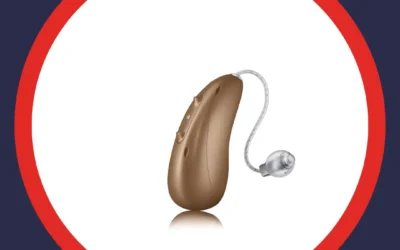
TL;DR: Choosing ReSound hearing aids comes down to five things: a design built around speech in noise, three current lines that suit different listeners, Bluetooth LE Audio with Auracast, rechargeable styles made for real hands, and a fitting that decides whether any of it helps. Which line fits depends on where your hearing gets hard, not on which one launched last.
Choosing ReSound hearing aids usually starts after someone has already tried turning up the television and asking people to repeat themselves. ReSound has spent decades on one problem in particular, following a single voice while a room works against you, and its newest line goes at that problem directly. Below are the five reasons the brand keeps coming up in our fitting rooms, and the one that decides whether the other four matter.

Reason 1: ReSound Designs Around Speech in Noise
People start choosing ReSound hearing aids for one situation in particular: a room with more than one voice in it. That is what ReSound builds toward first, and it is worth understanding about hearing loss before you judge any brand on it. About 28.8 million U.S. adults could benefit from using hearing aids, according to NIDCD statistics, and the people who put it off tend to describe the same thing. They can hear that someone is talking. The words themselves will not come out of the room.
ReSound’s answer runs in three steps rather than one. The aid classifies the environment you are standing in, narrows its microphones toward the person in front of you, then reduces what is left over. On Sensia, the newest line, ReSound calls that combination Intelligent All-Around, and reports that its AcoustIQ classifier engages the right features with 88 percent greater accuracy than the closest premium solution, with listeners preferring the four-microphone beam 93 percent of the time.
That order is why two people with similar test results can land on different technology levels:
- Someone eating out four nights a week leans hardest on the classification step, because the room keeps changing underneath them
- Someone who mostly talks one to one at home rarely gets past the first step, so the extra automation buys less
- Someone in open-plan meetings all day needs the beamformer more than the noise reduction, since the competing sound is other speech
Where you spend your hard listening hours predicts the right tier better than an audiogram does on its own.
Reason 2: Three Current Lines, Not One Catalog Answer
Choosing ReSound hearing aids does not mean choosing one device. We fit three current families, and they are built for different people rather than stacked newest to oldest.
| Line | Built for | What stands out | Technology levels we carry |
|---|---|---|---|
| Sensia | Sorting a busy room in real time | Intelligent All-Around, in the smallest cabinet ReSound has built | 9 and 7 |
| Vivia | Hearing in noise | The first Auracast Assistant inside a hearing aid app | 9 and 7 |
| Nexia | Wearers who reject aids on size alone | The M&RIE receiver, with a third microphone in the ear canal | 9 and 7 |
Sensia is the current release and the one ReSound is advertising hardest, so it is worth knowing where the headline stops. Intelligent All-Around is a Tech Level 9 feature in the microRIE style, and ReSound calls that microRIE the world’s smallest AI RIE, 6 percent smaller than its closest competitor. We carry Sensia in the 9 and the 7. The 7 runs 14 fine-tuning channels against the 9’s 17, keeps Bluetooth LE Audio with Auracast, IP68 protection and the M&RIE receiver option, and suits someone whose hard listening happens in moderate noise rather than every night in a crowded room.
You will also still hear about ReSound Omnia, an earlier generation we continue to fit. If you already wear a pair, we service and reprogram them here, and we can put them next to a newer line at your next visit. When the choice narrows to two, compare Vivia and Nexia before you come in, then bring the question to a fitting.

Reason 3: Connectivity That Works in Rooms You Do Not Control
Streaming from your own phone is the easy part, and every current ReSound line does it. The harder problem is audio you have no control over, which is where Bluetooth LE Audio and Auracast change the picture. Auracast lets a venue broadcast its own sound straight to your hearing aids, so a gate announcement, a theater performance or a house of worship reaches you without a neck loop or a borrowed receiver at the desk.
Vivia introduced the Auracast Assistant inside the ReSound Smart 3D app, which is the part that finds an available broadcast and joins it. Sensia and Nexia carry Bluetooth LE Audio with Auracast as well, so the capability is not confined to one line.
Three things this changes in ordinary weeks:
- Phone calls run hands-free through the aids rather than through a speaker you have to hold up
- Television streams directly instead of being turned up for everyone else in the house
- A saved app profile for a place you visit weekly loads again when you walk back in
None of it replaces a fitting, and all of it removes a daily workaround. If the connectivity question is the one you came with, read our guide to hearing aids with Bluetooth and what Auracast means for people wearing them.
Reason 4: Rechargeable Designs Made for Real Hands
Charge overnight, wear them all day. ReSound rates its rechargeable models at up to 30 hours on a full charge, with roughly 24 hours on a typical day that includes streaming and the noise features running, and a full charge takes about three hours.
The convenience is the smaller half of this. Anyone with arthritis, a tremor or reduced feeling in the fingertips has fought a size 312 battery door at some point, usually at the worst moment, and removing that step removes a weekly frustration rather than a yearly one. Battery models are still made where a wearer prefers them, including a size 13 option with a telecoil, so rechargeable is a default rather than a requirement.
Reason 5: The Fitting Decides Whether Any of It Helps
This is the reason that governs the other four, and it is the one most comparison articles skip. Choosing ReSound hearing aids well has less to do with the model than with what happens after you pick it. A hearing aid is not a product you select. It is a prescription you wear, and the prescription comes from the test rather than from the box.
Here is how that works. A full hearing test measures the softest sound you can detect at each pitch, and how well you separate words when volume is no longer the obstacle. Those results produce a target: a specific amount of gain at each frequency, for your specific loss. That target does not change when you move up a technology level. What changes is how many fine-tuning channels a provider has to shape the target with, and how much the aid decides on its own when your environment shifts. At many of our locations, a provider then runs real ear measurement, placing a thin probe microphone in your ear canal to measure what the aid delivers at your eardrum rather than what the fitting software predicts it will.
| What the technology level changes | What it does not change |
|---|---|
| Fine-tuning channels available to your provider | Your prescription, which comes from the test |
| How much the aid automates when the room shifts | Whether the aid is verified at your eardrum |
| How hard the aid works in complex noise | The physical fit and receiver choice |
| Which features are switched on at all | How long adaptation takes |
That distinction is the whole reason a mid-tier aid fitted carefully outperforms a flagship fitted by prediction. If you are still weighing whether it is time at all, the signs you need a hearing aid are a reasonable place to start, and you can find a clinic near you when you are ready to test rather than guess.

What Choosing ReSound Hearing Aids Looks Like Here
American Hearing + Audiology is locally owned and operated, and we fit five premium brands rather than one, so a ReSound recommendation has to earn its place against Phonak, Starkey, Oticon and Unitron every time. That matters more than it sounds. A single-brand seller has one answer to give you. Options across price tiers, and a reason to put the right one in front of you, come with having more than one answer available.
We are in network with many major plans, and we verify your benefits before you commit to anything, which is usually the fastest way to find out what a plan covers. Real ear measurement is available at many of our locations. Every aid we fit is unlocked, so it can be serviced and adjusted without sending you back to one store. A 7-day trial lets you hear the difference before you commit, in your own kitchen and your own restaurant rather than in a quiet fitting room.
Talk with a hearing care provider who listens. Find a clinic near you and start with a free hearing screening. If you want the wider view first, our ReSound lineup sits alongside a look at ReSound next to Starkey.
Choosing ReSound Hearing Aids: Common Questions
Does ReSound Make Anything for Severe or Profound Hearing Loss?
Yes. ReSound Enzo IA is the super power line built for severe to profound loss, with up to 28 hours of use, about 20 hours when streaming half the time, and Bluetooth LE Audio with Auracast. At American Hearing + Audiology, our providers fit power devices from more than one manufacturer, so the answer for a profound loss is rarely settled by brand alone.
Can I Put Insurance Benefits Toward a ReSound Hearing Aid?
Often, though what a plan covers varies more than whether we can take it. Most health plans do not administer hearing benefits themselves, they contract a third party administrator who decides which devices are in the benefit and at which technology levels. We accept every hearing benefit network, and we can also take an HSA or FSA card. Our page on hearing aid insurance benefits walks through how the administrator layer works.
How Long Does It Take to Adjust to a New ReSound Hearing Aid?
Most people need a few weeks, not a few days. Your brain has usually been filling in missing sound for years, and returning that sound makes ordinary rooms feel loud before they feel normal again. At American Hearing + Audiology, our providers use the trial period for exactly this, adjusting after you have lived with the aids rather than only at the first fitting.
Do ReSound Hearing Aids Work With Both iPhone and Android?
Yes. Current ReSound lines stream directly from compatible iOS and Android devices and are controlled through the ReSound Smart 3D app on either platform, with Apple Watch control available on iPhone. Hands-free calling depends on your specific phone model and its software version, which is worth checking against the phone in your pocket rather than assuming.