Updated September 2026
TL;DR: Hearing aids for noisy environments live or die on one thing: whether the device commits real processing power to separating a voice from a room. Two current models run a second chip built for exactly that. The rest manage with directional microphones and noise reduction. Fitting still matters more than ranking.
Hearing aids for noisy environments are the hardest category to shop for. The difference between them only shows up somewhere you cannot test, and a quiet showroom tells you nothing. This page ranks the five we fit by how much of the device is aimed at noise. Then it says plainly what none of them can do.
What to Look For in Hearing Aids for Noisy Environments
Four features do the work in a loud room, and they are not equally important.

- A dedicated noise processor. This is a second chip working only on separating speech from babble, and it is the biggest single differentiator on the market today.
- Directional microphones. Two microphones per device, favoring what is in front of you. Older technology, still one of the most effective.
- Automatic program switching. The device recognizes a noisy room and changes settings without you touching anything.
- Remote microphone support. Most underrated item on this list, and often the one that helps most.
The first item is a hardware question you can answer before you book, which makes it the useful thing to compare.
Worth knowing how common the problem is. About one in three people in the U.S. aged 65 to 74 has hearing loss, according to NIDCD research. Noise is usually where they notice it.
The 5 Best Hearing Aids for Noisy Environments
Ranked by how much of the device is committed to noise, not by price.
| Rank | Model | Dedicated noise chip | Channels | Battery |
|---|---|---|---|---|
| 1 | Phonak Audéo EON Sphere 90 | ✓ | 20 | 38 hours |
| 2 | ReSound Sensia 9 | ✓ | 17 | 24 hours |
| 3 | Starkey Edge AI 24 | No | 24 | 51 hours |
| 4 | Phonak Audéo EON R 90 | No | 20 | No published figure |
| 5 | Unitron | Ask your provider | Varies by tier | Ask your provider |
The gap between rows two and three is the real story on this page. Everything above the line runs silicon built for the problem. More detail sits on our Phonak hearing aids and ReSound hearing aids pages.
1. Phonak Audéo EON Sphere 90
The Sphere family runs two chips. ERA handles processing and every connection. HYPERSONIC does nothing but run real-time AI on incoming sound. Spheric Speech Clarity 3.0 and AutoSense OS AI 8.0 both sit on this family.
- Why it leads: more of this device is aimed at noise than any other we fit.
- Also worth knowing: universal Bluetooth pairs with any operating system, and it runs about 38 hours per charge.
- Trade-off: no CROS option and no telecoil listed.
2. ReSound Sensia 9
Sensia replaced the Vivia generation in August 2026. It takes the same two-chip approach with different architecture, a 360 chip for the sound and a separate DNN chip running neural noise reduction.
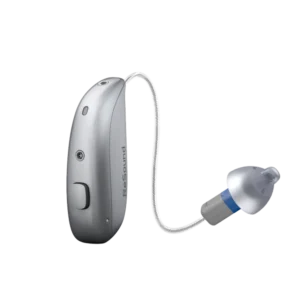
- Why it is here: a second processor built for noise, in one of the smallest rechargeable shells available.
- Also worth knowing: it pairs with a CROS device, which the Phonak Sphere family does not.
- Trade-off: 24 hours per charge is the shortest battery in this group.
3. Starkey Edge AI 24
Starkey attacks noise with 24 fine-tuning channels, the most in this comparison. Directional microphones and on-device processing do the rest, rather than a separate chip.
- Why it is here: the finest control your provider can apply at follow-up, which matters more than people expect.
- Also worth knowing: health and activity tracking are built in, and the battery runs about 51 hours.
- Trade-off: no telecoil.
4. Phonak Audéo EON R 90
The R family runs the ERA chip alone. Connectivity matches Sphere and the dedicated noise silicon is absent, so it earns its place here for a different reason entirely.
- Why it is here: it is the only model we fit that pairs with a CROS device. For single-sided hearing in a loud room, that beats noise processing on the wrong ear. See what a CROS hearing aid does.
- Also worth knowing: 20 fine-tuning channels and the same IP68 build as the Sphere family.
- Trade-off: in a restaurant, Sphere will outperform it.
5. Unitron
Unitron builds comfortable devices across flexible technology levels, which suits someone who wants to step up or down without changing hardware. Our providers fit the line and will show you where it sits against the four above. Unitron hearing aids has the brand detail.
- Why it is here: fit and flexibility, rather than a noise-processing claim.
- Ask your provider for the current Unitron model and its noise features, because they change by tier.
What None of Them Can Do
Every page ranking hearing aids for noisy environments should end with this section, and most do not.

- Competing voices stay hard. Steady noise is solvable. A table of six people talking is not, for any device sold today.
- Directional microphones assume the talker is in front of you. Turn your head and the benefit turns with it.
- Reverberation beats the processing. Hard floors and high ceilings do more damage than raw volume.
- A poorly programmed flagship loses to a well-fitted mid-tier. Every time.
That last line is why the ranking matters less than the appointment. Our piece on hearing aids and speech in noise goes deeper.
How to Hear Better in Noise Without Buying Anything
These cost nothing and they work with any device, or none.
| Do this | Why it works |
|---|---|
| Sit with your back to a wall | Directional microphones suppress sound from behind you |
| Pick booths over open rooms | Soft surfaces cut the reverberation that defeats processing |
| Face the person talking | Lip reading adds more than most people realize |
| Ask for different words, not louder ones | A rewording carries different consonants, and consonants are what went missing |
| Try a remote microphone | It removes the distance between the talker and the microphone, which no processing can do |
The bottom row outperforms every device in this article. It is worth asking about before you spend a step up in tier.
One more thing worth saying, because it costs nothing and almost nobody does it. Tell the people you eat with what helps. Most of them have no idea that facing you, or moving to a quieter table, or saying it a different way does more than raising their voice. Raising a voice usually makes it worse, because volume distorts the consonants that were already the problem.
Choosing Hearing Aids for Noisy Environments with American Hearing + Audiology
Noise is the complaint our providers hear most, and the one a spec table settles least well. We carry five premium brands and recommend across all of them, so what you leave with follows your hearing test rather than our inventory. Options run from entry level through premium flagship. Using your insurance is often part of the picture, because we are in network with many major plans.
What comes with a fitting here:
- A 7-day trial lets you hear the difference before you commit, in your own noisy rooms.
- Real ear measurement is available at many locations, so the fitting is verified rather than estimated.
- Hearing aids fitted with us are unlocked, so they can be serviced elsewhere if you move.
- We can check your benefits before you decide anything.
- Locally owned and operated means the person who fits you is the person you see at follow-up. Meet our team shows you who that is.
Hearing better starts with one conversation. Book a free hearing screening and find a clinic near you.
Hearing Aids for Noisy Environments, Answered
Which hearing aids work best in restaurants?
Models with a second chip built for separating speech from babble lead. Today that means the Phonak Audéo EON Sphere and the ReSound Sensia. Our providers at American Hearing + Audiology test speech in noise specifically, because a quiet-booth result does not predict a restaurant.
Do I need the top tier for noisy environments?
Often yes, and not always. Higher tiers switch on more of the noise processing, so someone who eats out several times a week usually hears the difference. Someone whose hard rooms are occasional may not, and paying for headroom you never use is a real risk.
Can hearing aids remove background noise completely?
No. Steady noise like traffic or a fan can be reduced substantially. Other people’s voices cannot, because they look like speech to the device, and no manufacturer has solved that.
What is a remote microphone and do I need one?
It is a small microphone that sits with the person you want to hear and sends their voice straight to your hearing aids. In a loud room it outperforms on-device processing. Your provider at American Hearing + Audiology can tell you whether your devices support one.
How do I try hearing aids in a real noisy environment?
A 7-day trial lets you hear the difference before you commit, and it applies to every brand and model we carry. Take them somewhere loud on purpose. If the hearing aids are not right for you, bring them back within the trial and your provider will talk through your options.
Talk with a hearing care provider who listens, and find a clinic near you.