
Updated October 2026
TL;DR: On the scale of degrees of hearing loss, severe means the softest sounds you can hear sit between 71 and 90 dB HL. The right hearing aid for that range has enough output headroom, a fit that does not whistle, and processing that keeps speech audible. Ask for an ultra power (UP) receiver or a power style. Then ask to have the fitting checked with real ear measurement.
Severe hearing loss turns a dinner table into guesswork, because a standard hearing aid often runs out of power before the words turn clear. The best hearing aids for severe hearing loss pair a high-output receiver with a fit that holds that power in your ear without feedback. Four current product lines from the brands we carry meet that bar. Your audiogram, and the places you struggle most, decide which one suits you.
What Counts as Severe Hearing Loss on an Audiogram?
Severe hearing loss means your hearing thresholds fall between 71 and 90 dB HL, according to the American Speech-Language-Hearing Association. A threshold is the softest level at which you can detect a tone, so a higher number means a quieter world. At 71 dB HL and beyond, ordinary conversation sits at or below the edge of what you can hear unaided.
Your audiogram rarely shows one tidy number. Many people have severe loss in the high pitches and milder loss in the low ones. That pattern shapes the hearing aid as much as the overall label does. Our guide to reading your audiogram walks through how the chart is built.
Severe sits fourth of the five bands on the ASHA scale.
| Degree | Threshold range (dB HL) | What it tends to mean day to day |
|---|---|---|
| Mild | 26 to 40 | Soft voices and whispers slip past |
| Moderate | 41 to 55 | Conversation in a quiet room takes effort |
| Moderately severe | 56 to 70 | Most conversation needs amplification |
| Severe | 71 to 90 | Speech is largely out of reach without a hearing aid |
| Profound | 91 and above | Even loud speech may not come through, aided or not |
Why Severe Loss Is a Power and Headroom Problem
A hearing aid for severe loss has to work inside a very narrow window. Your threshold has risen, but the level at which sound turns uncomfortable usually has not risen with it. The space between the two, called your dynamic range, shrinks. A 2018 clinical review notes that for people with severe to profound loss, that range may be only 20 to 30 dB. Picture fitting a whole conversation, from a whisper to a laugh, into a hallway instead of a ballroom.
Everyday speech covers a wider spread than that. So the hearing aid has to lift soft sounds a long way to clear your threshold, then squeeze loud sounds down so they stop short of discomfort. That takes a lot of gain at the bottom and a high output ceiling at the top. When the ceiling sits too low, loud speech hits it and distorts. If the gain falls short, soft consonants never arrive. People describe the result as a hearing aid that feels “completely underpowered.”
What a Severe-Loss Fitting Needs
Four things decide whether a hearing aid can do that job in your ear.
- Gain and output headroom. An ultra power (UP) receiver or a power behind-the-ear style gives the aid room to lift soft speech without running out of output.
- Feedback control. High gain leaks back to the microphone as a whistle unless the earpiece seals the canal and your provider sets the feedback canceller for your ear.
- Speech-preserving processing. Frequency lowering moves high-pitched speech sounds, like s and f, down into a range where you still have usable hearing.
- Verification in your ear. Real ear measurement confirms the aid delivers its prescription at your eardrum, not just in a test cavity.
Judge each of the best hearing aids for severe hearing loss on those four points. Each one also makes a fair question for your provider.
Power Receivers and Fitting Range: How to Read the Numbers
Two figures tell you how much power a receiver has. Maximum output, in dB SPL, is the loudest sound the hearing aid can produce. The second figure, maximum gain in dB, is how much louder the aid can make an incoming sound. A severe-loss fitting needs both, because gain clears your threshold and output sets the ceiling for loud speech. Those two figures are where the best hearing aids for severe hearing loss separate from standard models.
Manufacturers measure these in a 2cc coupler. That is a small, standardized test cavity, so every hearing aid gets tested on the same footing. Your ear canal is a different size and shape. The seal of your dome or earmold changes the result too. So the published figure is a fair way to compare devices. It cannot predict the sound level at your own eardrum.
Fitting range is the span of hearing loss a manufacturer says a device or receiver can serve. Phonak, for example, lists its Audéo EON with the UP receiver for moderate to profound loss. A gap of a few decibels between two models matters less than one question your provider can answer from your audiogram: does this receiver leave headroom above your prescription, or does it run near its limit all day?
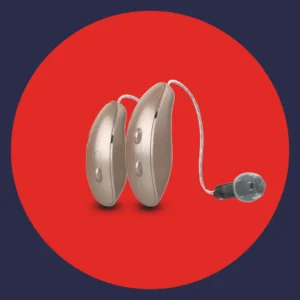
Comparison Chart: Best Hearing Aids for Severe Hearing Loss by Receiver Power
Every model in the chart is a current-generation receiver-in-canal hearing aid, shown with its ultra power receiver.
| Hearing aid | Receiver | Max output (2cc coupler) | Max gain (2cc coupler) | Best if |
|---|---|---|---|---|
| Phonak Audéo EON Sphere | UP | 132 dB SPL | 71 dB | Group conversation in noise is your hardest setting |
| Phonak Audéo EON R | UP | 132 dB SPL | 71 dB | You want a rechargeable that can pair with a CROS |
| Starkey Omega AI+ RIC RT | UP | 125 dB SPL (peak) | 67 dB (peak) | You use a telecoil loop and want a long charge |
| ReSound Sensia 9 or 7 | UP | 129 dB SPL | 71 dB | You want a choice of rechargeable or battery models |
| Unitron Moxi S-R | UP | 132 dB SPL | 71 dB | You want a rechargeable RIC with the same UP figures as Phonak |
Each figure comes from its manufacturer. Read the chart as a comparison between devices. The final call comes from a fitting on your own ears.
Brand-by-Brand: Which Severe-Loss Option Fits Which Listener?
With the right receiver, each of these four product lines reaches severe loss. What sets them apart is what they add around that power. Which one leaves you the most headroom is a read your provider makes from your audiogram. We also carry Oticon. Our providers can tell you which of its options suits your hearing.
Phonak Audéo EON Sphere and EON R
The EON line runs on Phonak’s HYPERSONIC chip. Both versions use AutoSense OS AI 8.0. The EON Sphere adds Spheric Speech Clarity 3.0, a deep neural network that separates speech from noise. Phonak reports that wearers are twice as likely to understand every word from any direction with it switched on. The EON R skips that feature but can pair with a CROS EON R. Phonak’s EON feature set also includes SoundRecover2 frequency lowering. Both charge for up to 38 hours, per Phonak. You can choose from several technology levels, including 90 and 70. Our page on the Audéo EON Sphere goes deeper on Spheric Speech Clarity.
Starkey Omega AI+
Inside the Omega AI+ sits Starkey’s G4 Gen AI Neuro Processor, with a neural network built into the chip. Edge Mode comes on by default in the first memory and gives a deep neural network boost for comfort in noise. The RIC RT style carries a telecoil, which picks up hearing loop systems in churches and theaters. Battery life runs up to 51 hours without streaming and up to 45 hours with it, per Starkey. Starkey lists its UP receiver figures as peak values, 125 dB SPL output and 67 dB gain.
ReSound Sensia
Three receiver-in-canal styles make up the Sensia range: the rechargeable 60S, the 61 on a size 312 battery, and the 62 on a size 13 battery with a telecoil. Level 9 runs 17 channels and level 7 runs 14. With the UP receiver, ReSound lists 129 dB SPL maximum output and 71 dB maximum gain. The rechargeable runs up to 30 hours, or about 24 hours with streaming. Sensia also supports Auracast broadcast audio.
Unitron Moxi S-R
Built on Unitron’s Smile platform, the Moxi S-R matches Phonak’s UP figures at 132 dB SPL and 71 dB. Unitron lists an expected operating time of 20 hours per charge. Our look at Unitron Smile hearing aids covers the platform in more depth.
RIC or Behind-the-Ear: Which Style Holds Up for Severe Loss?
For many people, the best hearing aids for severe hearing loss are receiver-in-canal models with a UP receiver. Its speaker sits in the ear canal, close to the eardrum, which keeps the sound path short. When an audiogram calls for more power, manufacturers also make power behind-the-ear styles that send sound through a tube to a custom earmold. Your provider picks the style from your audiogram, your ear canal, and how easily you handle small parts.
The seal matters as much as the style. Sound leaking out of the ear canal reaches the microphone and loops back as a whistle. The louder the aid runs, the more that leak shows. A custom earmold or a closed power dome holds the sound in. The aid’s feedback canceller handles what slips past. Our article on fixing hearing aid feedback explains the common causes.
Each style trades something.
- RIC with UP receiver. Small and discreet, with a replaceable receiver, though a very severe loss can push it near its output limit.
- Power behind-the-ear. More room for output and a sturdy custom earmold, in a larger case that sits behind the ear.
- Custom earmold on either style. The tightest seal against feedback, made from an impression of your ear, with a short wait for the mold.
Our guide to types of hearing aids compares every style side by side.
Why Real Ear Measurement Matters More at High Gain
Real ear measurement checks what the hearing aid delivers at your eardrum. At severe-loss gain levels, that check carries more weight. A few decibels lost to a loose seal or an unusual ear canal can drop soft speech back below your threshold. The 2018 review notes that best-practice guidelines call for prescriptive targets verified by real-ear measurement, across soft, moderate, and loud speech. That step is what turns any of the best hearing aids for severe hearing loss into a fitting that works in your ear.
Your provider places a thin, soft probe tube in your ear canal beside the hearing aid. Recorded speech plays at several levels while a microphone on the tube measures what reaches your eardrum. Then your provider adjusts the aid until the measured response meets the target for your audiogram. You can read more about real ear measurement and what it shows.
Real ear measurement is available at many of our locations. If you want your fitting checked this way, find a clinic near you and ask about it when you book.

When a Hearing Aid May Not Be Enough
Some losses move past what any hearing aid can make clear. Your provider will tell you if yours is nearing that point. As loss reaches the profound range, amplification can make sound louder without making speech understandable. At that stage, your provider may talk with you about a referral for further evaluation. Cochlear implants work differently from hearing aids. According to the National Institute on Deafness and Other Communication Disorders, they bypass damaged parts of the ear and stimulate the hearing nerve directly, while hearing aids amplify sound.
Severe loss in only one ear raises a different question. When one ear gets little benefit from amplification, a CROS system can route sound from that side to the better ear. Our guide to CROS hearing aids explains how that works.
Find Your Severe-Loss Fit at American Hearing + Audiology
Choosing among the best hearing aids for severe hearing loss starts with your audiogram, not a brand. Our providers carry five premium brands, Phonak, ReSound, Starkey, Oticon, and Unitron, so the recommendation follows your hearing rather than a single catalog. You get options across price tiers, entry level through premium.
Six things set a visit with our providers apart.
- Locally owned and operated. Your fitting and follow-up visits happen with a team in your community.
- Brand-neutral recommendations. With five manufacturers to choose from, the receiver and style match your audiogram, not a sales list.
- In-network insurance. We can check your benefits before you decide anything.
- Real ear measurement. Available at many locations to verify a high-gain fitting in your ear.
- 7-day trial. A 7-day trial lets you hear the difference before you commit.
- Unlocked hearing aids. Your devices are not tied to a single chain.
In your network, in your neighborhood, and in your corner. Hearing better starts with one conversation. Find a clinic near you and start with a free hearing screening.
Best Hearing Aids for Severe Hearing Loss: Your Questions Answered
Will insurance help pay for a power hearing aid?
Coverage depends on your plan, and we can check your benefits before you decide anything. American Hearing + Audiology is in network with many major plans, including TruHearing, Nations Hearing, and United Healthcare Hearing. Our page on hearing aid insurance benefits explains how those benefits usually work.
How long does it take to adjust to hearing aids with severe loss?
Expect it to take time. Sounds you have not heard in years can feel sharp or tinny at first. At American Hearing + Audiology, our providers often start below full prescription and raise the gain across follow-up visits as your brain relearns those sounds.
Can I stream phone calls through a hearing aid for severe loss?
Yes. Phonak Audéo EON, ReSound Sensia, and Starkey Omega AI+ all stream audio from a phone over Bluetooth. Of those, EON and Sensia also support Auracast broadcast audio.
What happens if my hearing aid needs a repair?
At American Hearing + Audiology, we provide loaner hearing aids while yours are out for repair, so you are not left without sound. Warranty coverage comes from the manufacturer and varies by model. Your provider will go through what your hearing aids include.
Should I wear two hearing aids if both ears have severe loss?
When both ears have loss, providers usually recommend a hearing aid for each. Hearing from both sides helps you judge where a sound comes from. Our providers review both sides of your audiogram before recommending a setup.